How Many SEO Keywords Per Page? The Complete 2024 Guide

TL;DR: Most SEO experts recommend targeting 1-2 primary keywords and 3-5 related secondary keywords per page for optimal results. When determining SEO keywords how many to use, focus on quality over quantity—naturally incorporating keywords while maintaining readability ensures better rankings and user experience than keyword stuffing.
Frequently Asked Questions

How many SEO keywords should I use per page?
Aim for 1 primary keyword and 2-4 related secondary keywords per page. Focus on natural integration rather than keyword stuffing. Modern SEO prioritizes topic relevance and user intent over keyword density. Use variations and semantic keywords throughout your content to signal topical authority to search engines while maintaining readability for users.
What is the ideal keyword density for SEO optimization?
The ideal keyword density is 1-2% of your total word count, though this metric is less critical than it once was. Instead of obsessing over percentages, focus on using your primary keyword naturally in title tags, headings, and throughout the content. Search engine optimization now prioritizes context and semantic relevance over exact keyword repetition.
How many keywords should I target with SEO automation tools?
SEO automation tools work best when targeting 10-50 keywords per content cluster, organized by search intent and topic relevance. Start with 3-5 primary topics for your business, then expand with long-tail variations. AI-powered SEO tools can help identify high-potential keywords and automate content creation, making it easier to scale your organic traffic growth strategy.
Can you use too many keywords in SEO search optimization?
Yes, using too many keywords leads to keyword stuffing, which harms your rankings and user experience. Google's algorithms penalize over-optimization. Instead, focus on one primary keyword per page with natural variations. Use webmaster tools like Google Search Console to monitor your keyword performance and ensure your content maintains quality while targeting relevant search terms.
How do I check how many keywords my page is ranking for?
Use Google Search Console, website traffic checker tools, or specialized SEO marketing tools to track keyword rankings. Google Search Console provides free data on queries driving page traffic. Premium SEO optimization services offer more detailed keyword tracking, including position changes, search volume, and competitor comparisons to help optimize your search engine marketing strategy.
How many long-tail keywords should I include in my SEO strategy?
Include 5-10 long-tail keywords per content piece, as they drive 70% of search traffic and have higher conversion rates. Long-tail keywords are less competitive and match specific user intent better than broad terms. SEO automation tools can help identify relevant long-tail variations and integrate them naturally into your content for improved rankings.
What's the difference between primary and secondary keywords in SEO?
Primary keywords are your main target terms that define the page's core topic, while secondary keywords are related variations and supporting terms. Use one primary keyword in your title, URL, and main headings. Secondary keywords (2-4 per page) support the primary topic and help search engines understand context, improving your overall SEO engine optimization performance.
How many keywords should beginners focus on for SEO marketing?
Beginners should start with 10-20 carefully selected keywords across their entire website, focusing on 1-2 keywords per page. Choose terms with moderate competition and clear search intent. Use a page traffic checker to monitor results before expanding. This focused approach helps you learn SEO fundamentals and achieve quicker wins before scaling your keyword strategy with advanced tools.
Understanding SEO Keywords: How Many Should You Target?

When it comes to seo keywords how many you should target, there's no one-size-fits-all answer. The optimal number depends on your content length, topic complexity, and overall SEO strategy. Most SEO professionals recommend focusing on one primary keyword and 3-7 related secondary keywords per page to maintain natural readability while maximizing search visibility. 🎯
The question of keyword quantity has evolved significantly with modern seo search optimization practices. Gone are the days of keyword stuffing—today's approach requires strategic balance between keyword targeting and user experience. Understanding the right keyword density can make the difference between ranking on page one or getting lost in the search results.
This comprehensive guide explores the optimal number of keywords for different content types, how to implement them effectively, and how modern seo engine optimization tools can help you automate the process for better results.
The Primary Keyword Rule: Quality Over Quantity
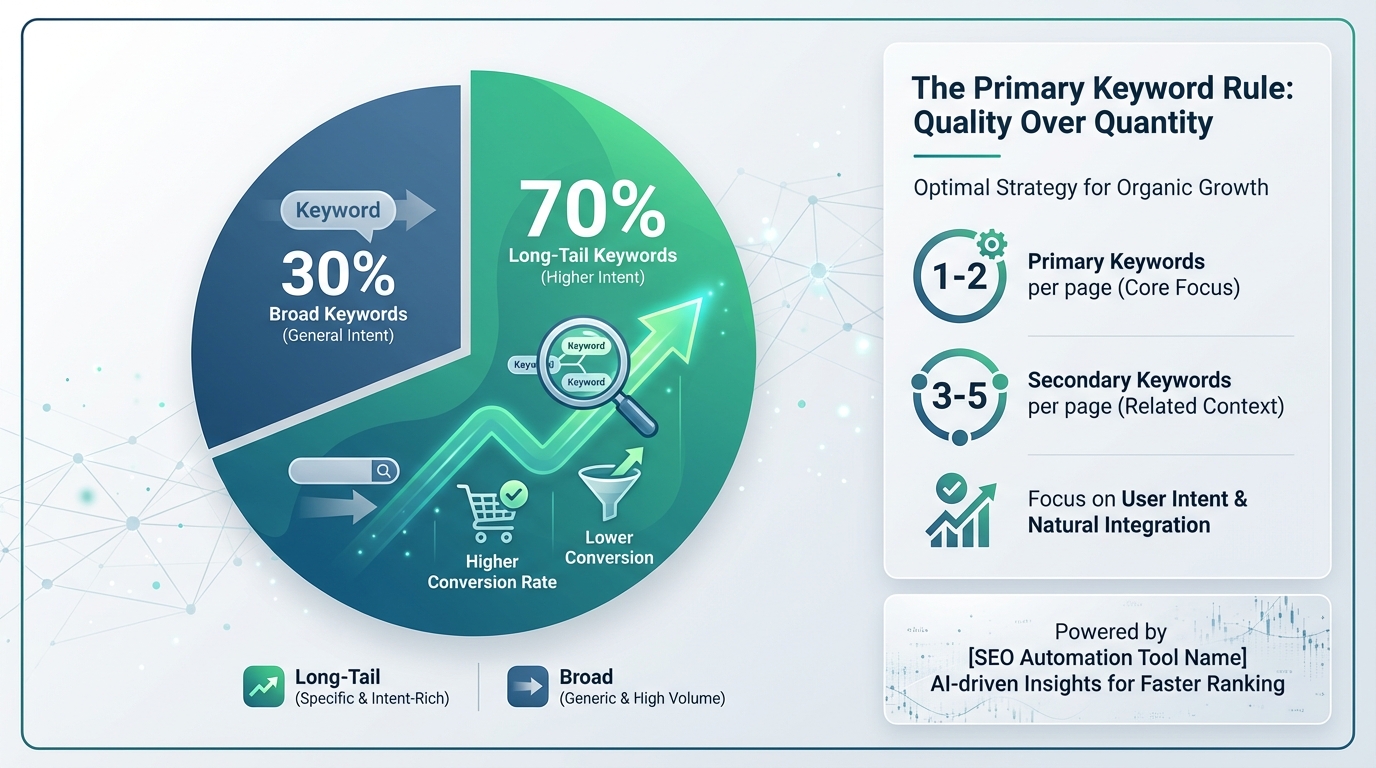
Every piece of content should revolve around one primary keyword—your main target phrase that directly matches user search intent. This keyword should appear in critical on-page elements and flow naturally throughout your content.
Where to Place Your Primary Keyword
Strategic placement matters more than frequency. Your primary keyword should appear in these essential locations:
- Title tag: Include it near the beginning for maximum impact
- First paragraph: Establish relevance immediately for both users and search engines
- At least one H2 heading: Reinforces topical relevance
- Meta description: Improves click-through rates from search results
- URL slug: Creates a clean, keyword-rich web address
- Image alt text: Enhances accessibility and image search optimization
Using Free SEO Title Generator - Generate SEO-Friendly Titles Instantly | IntentRank can help you craft compelling titles that incorporate your primary keyword naturally while maintaining user appeal.
Primary Keyword Density Guidelines
The ideal keyword density for your primary term ranges between 0.5% to 2.5% of total word count. For a 1,500-word article, this translates to approximately 8-38 mentions. However, natural usage should always trump arbitrary numbers. 📊
| Content Length | Minimum Mentions | Maximum Mentions | Optimal Range |
|---|---|---|---|
| 500 words | 3 | 12 | 4-6 |
| 1,000 words | 5 | 25 | 8-12 |
| 1,500 words | 8 | 38 | 12-18 |
| 2,000 words | 10 | 50 | 15-25 |
| 3,000+ words | 15 | 75 | 20-35 |
Secondary Keywords: Building Topical Authority
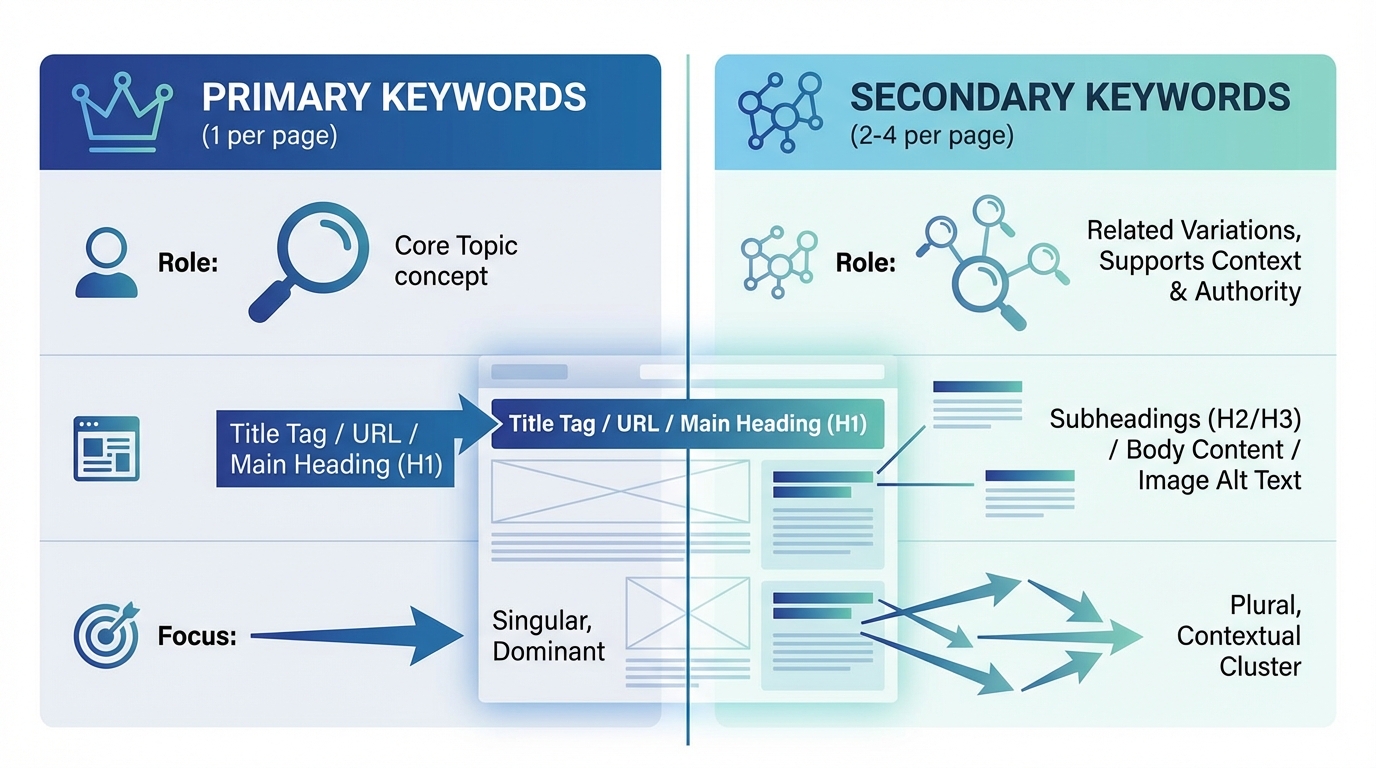
Secondary keywords complement your primary target and help search engines understand your content's full scope. These related terms capture additional search variations and improve your chances of ranking for multiple queries.
How Many Secondary Keywords Should You Target?
For most content pieces, targeting 3-7 secondary keywords provides optimal results without diluting your focus. These should be closely related to your primary keyword and naturally support your main topic.
Secondary keywords fall into several categories:
- Semantic variations: Different ways users search for the same concept
- Long-tail extensions: More specific phrases that include your primary keyword
- Related questions: Common queries users ask about your topic
- Supporting subtopics: Complementary subjects that enhance comprehension
Tools like Free Long Tail Keyword Generator - Generate SEO Long Tail Keywords Instantly | IntentRank can help identify valuable secondary keywords that align with search intent while offering lower competition opportunities.
Secondary Keyword Distribution Strategy
Each secondary keyword should appear 2-5 times throughout your content, depending on article length. Focus on incorporating them in subheadings, body paragraphs, and naturally within supporting arguments. ✨
Avoid forcing secondary keywords into every section. Instead, use them where they genuinely enhance clarity and provide additional context for readers and search engines.
LSI Keywords and Semantic SEO: The Modern Approach
Latent Semantic Indexing (LSI) keywords represent terms and phrases semantically related to your main topic. Modern seo optimization services leverage these keywords to demonstrate comprehensive topic coverage without repetitive keyword usage.
Understanding LSI in Search Engine Optimization
Search engines use LSI to understand content context and relevance. Instead of counting exact keyword matches, algorithms analyze the presence of related terms that naturally occur when discussing a topic thoroughly.
For example, an article about "coffee brewing" would naturally include LSI terms like:
- Espresso, French press, pour-over
- Grind size, water temperature, extraction time
- Beans, roast levels, flavor profiles
- Barista, café, brewing methods
How Many LSI Keywords to Include
Aim for 10-20 LSI keywords naturally distributed throughout longer content pieces. These shouldn't be forced—they emerge organically when you write comprehensively about your subject matter.
Using seo marketing tools with AI capabilities can identify LSI opportunities automatically, ensuring your content covers all relevant semantic territory without manual research.
Content Length and Keyword Capacity
The relationship between content length and keyword targeting is crucial for effective search engine marketing. Longer content naturally accommodates more keywords while maintaining readability and user engagement.
Keyword Targeting by Content Type
| Content Type | Word Count | Primary Keywords | Secondary Keywords | Total Keyword Focus |
|---|---|---|---|---|
| Blog Post | 800-1,500 | 1 | 3-5 | 4-6 |
| Pillar Content | 2,000-3,500 | 1-2 | 5-10 | 6-12 |
| Product Page | 500-1,000 | 1 | 2-4 | 3-5 |
| Category Page | 300-800 | 1 | 2-3 | 3-4 |
| Ultimate Guide | 3,500-5,000+ | 1-2 | 8-15 | 9-17 |
Scaling Keywords for Comprehensive Content
Longer content allows for more keyword variations without appearing spammy. A 3,000-word comprehensive guide can comfortably target 10-15 total keywords, while a 500-word blog post should focus on 3-5 keywords maximum.
The key is maintaining a natural reading experience. If keyword placement disrupts flow or feels forced, reduce your keyword count regardless of content length. 📝
Monitoring Keyword Performance with Analytics Tools
Tracking keyword performance is essential for understanding whether your targeting strategy works effectively. Modern seo marketing tools provide comprehensive insights into rankings, traffic, and user engagement metrics.
Essential Metrics to Track
Monitor these key performance indicators to evaluate keyword effectiveness:
- Search rankings: Track position changes for target keywords over time
- Organic traffic: Measure visitors arriving through keyword searches
- Click-through rate: Evaluate how compelling your titles and descriptions are
- Bounce rate: Assess whether content meets user expectations
- Time on page: Gauge content engagement and relevance
- Conversion rate: Determine if traffic converts to desired actions
Using Google Search Console for Keyword Insights
The webmaster tools google search console provides invaluable data about which keywords drive traffic to your pages. The Performance report shows:
- Queries that trigger your content in search results
- Average position for each keyword
- Impressions and clicks per query
- Unexpected keywords you're ranking for
This data often reveals ranking opportunities you hadn't considered, allowing you to optimize existing content for additional keywords without creating new pages.
Page Traffic Checker and Website Traffic Checker Tools
Using a reliable page traffic checker helps identify which pages perform best and which keywords drive the most valuable traffic. A comprehensive website traffic checker reveals patterns in user behavior, showing how visitors navigate between pages and which content keeps them engaged.
These insights inform future keyword strategies by highlighting what works and what needs improvement. If certain keywords drive traffic but high bounce rates, your content may not match search intent despite ranking well. 🔍
Keyword Cannibalization: When Too Many Keywords Hurt
Targeting too many similar keywords across multiple pages creates keyword cannibalization—when your own content competes against itself in search results. This dilutes ranking power and confuses search engines about which page to prioritize.
Identifying Cannibalization Issues
Signs of keyword cannibalization include:
- Multiple pages ranking for the same keyword but none reaching page one
- Fluctuating rankings as search engines switch between your pages
- Lower click-through rates due to multiple similar listings
- Reduced authority as link equity spreads across duplicate content
Preventing Keyword Conflicts
Maintain a keyword mapping document that assigns specific keywords to specific pages. This ensures each page has unique targets and prevents overlap. When creating new content, check existing pages first to avoid competing with yourself.
If cannibalization occurs, consolidate content by merging similar pages, implementing 301 redirects, or clearly differentiating keyword targets to serve distinct search intents.
Search Intent and Keyword Selection
Understanding search intent is crucial when determining seo keywords how many to target. Different intent types require different keyword strategies to match user expectations effectively.
Four Types of Search Intent
| Intent Type | User Goal | Keyword Focus | Recommended Count |
|---|---|---|---|
| Informational | Learn or understand | How-to, what is, guide | 5-10 keywords |
| Navigational | Find specific site/page | Brand names, specific pages | 1-3 keywords |
| Commercial | Research before buying | Best, review, comparison | 4-8 keywords |
| Transactional | Make a purchase | Buy, price, discount | 2-5 keywords |
Tools like Free Search Intent Analyzer | IntentRank help identify the primary intent behind keywords, ensuring your content and keyword strategy align with what users actually want.
Matching Keywords to Content Purpose
Informational content benefits from broader keyword targeting since users explore multiple related topics. Transactional pages should focus narrowly on high-intent keywords that signal purchase readiness.
This intent-based approach to seo optimization service ensures your keyword count matches content purpose rather than following arbitrary rules. 🎯
Competitive Keyword Analysis: Learning from Rankings
Analyzing competitor keyword strategies reveals valuable insights about optimal keyword counts and targeting approaches in your niche. This competitive intelligence informs your own strategy without requiring guesswork.
What to Analyze in Competitor Content
When examining top-ranking pages for your target keywords, evaluate:
- How many total keywords they target per page
- Keyword density and placement patterns
- Content length relative to keyword count
- Balance between primary and secondary keywords
- LSI keyword usage and semantic coverage
Learning how to find competitor sites and analyze their keyword strategies provides actionable benchmarks for your own content optimization efforts.
Competitive Gap Analysis
Identify keywords your competitors rank for that you don't. These gaps represent opportunities to expand your keyword targeting without creating entirely new content—often you can optimize existing pages to capture these additional rankings.
However, don't simply copy competitor strategies. Use competitive data as a starting point, then differentiate by providing more comprehensive coverage, better user experience, or unique insights that set your content apart.
Automation Tools for Keyword Optimization
Modern seo marketing tools automate keyword research, analysis, and optimization, making it easier to determine optimal keyword counts and implementation strategies without manual guesswork.
Benefits of AI-Powered SEO Tools
AI-driven platforms offer several advantages for keyword strategy:
- Automated keyword research: Discover hundreds of relevant keywords in minutes
- Intent classification: Automatically categorize keywords by search intent
- Content gap analysis: Identify missing keywords and topics
- Real-time optimization: Get suggestions while writing content
- Performance tracking: Monitor rankings and traffic automatically
Platforms specializing in AI Search Engine Optimization Tools That Drive Real Traffic combine multiple functions into unified workflows, streamlining the entire keyword optimization process.
Automating Keyword Implementation
Advanced seo optimization services now use AI to automatically suggest optimal keyword placement, density, and variations while you create content. This ensures technical optimization without disrupting your creative flow or requiring constant manual adjustments.
Automation is particularly valuable for scaling content production across multiple topics while maintaining consistent SEO quality standards. 🚀
Local SEO Keyword Strategies
Local businesses require different keyword approaches than national or global brands. Geographic modifiers and location-specific intent change how many keywords you should target and how to implement them.
Local Keyword Targeting Guidelines
For local seo engine optimization, focus on:
- Primary location keyword: Your service + city/neighborhood
- 2-3 service variations: Different ways customers describe your offering
- 1-2 secondary locations: Nearby areas you serve
- Local modifiers: "Near me," "in [area]," "local"
Local pages typically target fewer keywords (3-6 total) but with higher geographic specificity. The reduced keyword count is offset by lower competition and more qualified traffic.
Using specialized Best Local SEO Audit Tools to Boost Rankings Fast helps identify location-specific keyword opportunities and optimization gaps that generic SEO tools might miss.
E-commerce Keyword Strategy: Product and Category Pages
E-commerce sites face unique keyword challenges due to large product catalogs and category structures. The right keyword count varies significantly between product pages, category pages, and informational content.
Product Page Keyword Guidelines
Individual product pages should focus narrowly on:
- 1 primary product keyword (exact product name or category)
- 2-3 product attribute keywords (color, size, material)
- 1-2 brand or model variations
- 1-2 benefit-focused keywords
Total keyword focus: 4-8 keywords per product page. More than this creates dilution and confusion about product specificity.
Category Page Optimization
Category pages can target slightly more keywords since they cover broader product groups:
- 1 primary category keyword
- 3-5 subcategory or product type variations
- 2-3 use case or application keywords
Category pages benefit from internal linking to product pages, distributing keyword authority throughout your site structure while maintaining focused targeting on each page.
Content Clusters and Topic Authority
Modern seo search optimization increasingly favors topic clusters—groups of related content linking to a comprehensive pillar page. This structure changes how you think about keyword distribution across multiple pages.
Pillar Page Keyword Strategy
Your pillar page targets the broad topic keyword plus 8-12 related subtopic keywords. This page provides comprehensive overview coverage without going deep into specifics.
Cluster Content Keyword Focus
Each cluster page focuses on one specific subtopic keyword from your pillar page, plus 3-5 related long-tail variations. This creates a network of focused content that collectively establishes topical authority.
The cluster model allows you to target 50+ total keywords across a topic without keyword stuffing any single page. Each piece maintains focused targeting while contributing to broader topical relevance.
Measuring Success: When Keyword Count is Right
How do you know if you're targeting the right number of keywords? Several indicators reveal whether your keyword strategy hits the sweet spot or needs adjustment.
Positive Performance Indicators
Your keyword count is optimal when you observe:
- Steady ranking improvements: Gradual position increases for target keywords
- Low bounce rates: Visitors stay engaged with your content
- Multiple keyword rankings: Single pages rank for several related queries
- Natural readability: Content flows smoothly without forced keyword placement
- Increasing organic traffic: More visitors discover your content through search
Warning Signs of Keyword Issues
Reduce your keyword count if you notice:
- Declining rankings despite optimization efforts
- High bounce rates suggesting content doesn't match intent
- Awkward phrasing or repetitive keyword usage
- Difficulty creating natural, engaging content
- Keyword cannibalization across multiple pages
Regular audits using your page traffic checker help identify these issues early, allowing course correction before significant ranking damage occurs. 📈
Future-Proofing Your Keyword Strategy
Search algorithms continuously evolve toward better understanding natural language and user intent. Future-proof keyword strategies focus less on exact match keywords and more on comprehensive topic coverage.
Emerging Trends in Keyword Optimization
Several trends are reshaping how we think about keyword targeting:
- Voice search optimization: Conversational, question-based keywords
- Entity-based SEO: Focus on topics and concepts rather than keyword strings
- Semantic search: Understanding meaning and context over exact matches
- AI-generated content: Automated optimization at scale
- User experience signals: Engagement metrics influencing rankings
Adapting Your Approach
Rather than rigidly targeting specific keyword counts, develop flexible strategies that prioritize:
- Comprehensive topic coverage over keyword repetition
- Natural language patterns that match how users actually search
- Content quality and user satisfaction over technical optimization
- Semantic relationships between concepts
This approach ensures your content remains effective regardless of algorithm updates or changing search behaviors.
Practical Implementation: Your Keyword Action Plan
Ready to optimize your keyword strategy? Follow this systematic approach to determine and implement the right keyword count for your content.
Step-by-Step Keyword Planning Process
- Identify your primary keyword: Choose one main target that matches your content purpose and user intent
- Research secondary keywords: Find 3-7 related terms that support your primary keyword
- Analyze competitor content: Review top-ranking pages to understand successful keyword patterns
- Map keywords to content structure: Assign specific keywords to headings and sections
- Write naturally first: Create engaging content without forcing keyword placement
- Optimize strategically: Add keywords in key locations while maintaining readability
- Monitor and adjust: Track performance and refine your approach based on results
Quick Reference Guide
Use this simple formula to determine keyword count:
- Short content (500-800 words): 1 primary + 2-3 secondary = 3-4 total keywords
- Medium content (1,000-1,500 words): 1 primary + 4-6 secondary = 5-7 total keywords
- Long content (2,000-3,000 words): 1-2 primary + 6-10 secondary = 7-12 total keywords
- Pillar content (3,000+ words): 1-2 primary + 10-15 secondary = 11-17 total keywords
Remember: these are guidelines, not rigid rules. Always prioritize user experience and natural language over hitting specific keyword counts. ✅
Conclusion: Finding Your Perfect Keyword Balance
The question of seo keywords how many doesn't have a universal answer—it depends on content type, length, intent, and industry competition. However, the principles remain consistent: focus on one primary keyword, support it with 3-7 secondary keywords, and enhance everything with natural LSI terms.
Modern seo optimization service approaches prioritize comprehensive topic coverage and user satisfaction over arbitrary keyword counts. By focusing on search intent, maintaining natural readability, and using data-driven tools to guide your strategy, you'll find the optimal keyword balance for your specific content needs.
Success in search engine marketing comes from continuous testing, monitoring, and refinement. Use your website traffic checker and analytics tools to evaluate what works, then iterate based on real performance data rather than assumptions.
Ready to automate your keyword research and optimization process? Visit IntentRank to discover how AI-powered SEO automation can help you identify the perfect keyword targets, create optimized content at scale, and grow your organic traffic faster than ever before. Stop guessing about keyword strategy and start leveraging intelligent automation to rank higher and drive real results. 🚀
Article created using IntentRank

